For over 30 years Chuck E. Cheese has been the premiere mascot character of family entertainment restaurants. His long tenure and popularity has made him one of the most popular advertising characters of all time. According to a 2007 Cartoon Q Ranking Study among kids ages 6-8, Chuck E. Cheese ranked among the top 4 percent of favorite characters - ahead of Mickey Mouse, Ronald McDonald, The Flintstones, Barbie and Snoopy1.
Character Origins / Design
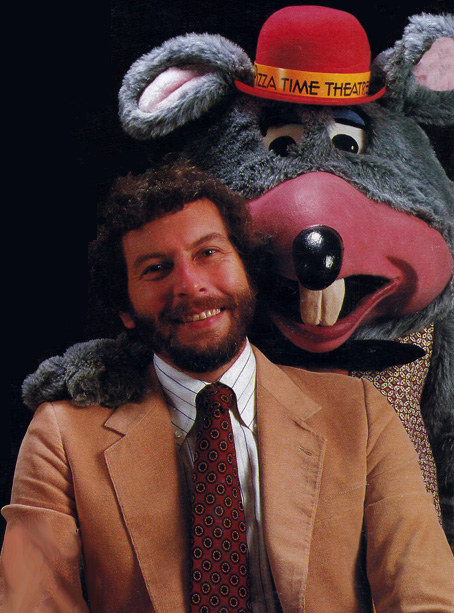
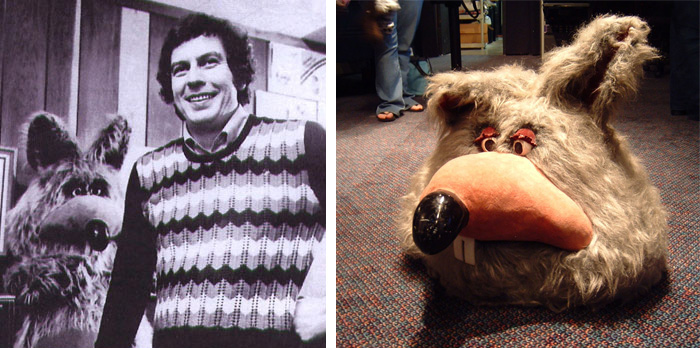
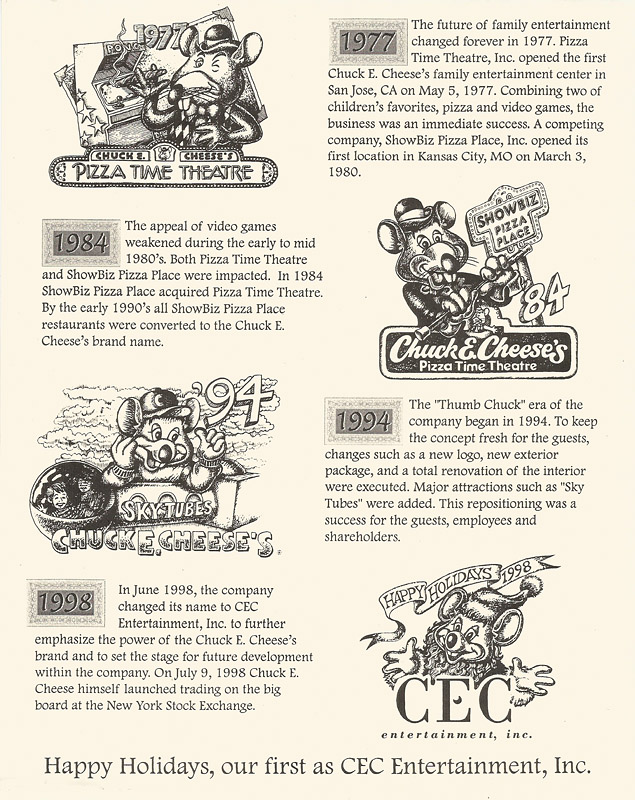
Chuck E. Cheese made his debut in 1977 at the first Pizza Time Theatre restaurant in San Jose, CA2. During the initial planning stages, the idea and design for Chuck E. came from a generic mascot-character costume obtained at an IAAPA trade show by Nolan Bushnell, the co-founder and head of Atari. It was assumed to be a coyote, which prompted the original working title of the restaurant concept to be "Coyote Pizza". Bushnell had the costume shipped back to Atari and once it arrived they noticed a large pink tail indicating it was actually a rat. Rather than find a replacement costume, they kept it and went with the rat theme and changed the restaurant name3. The costume head was handed to Bushnell's engineers who were instructed to "make him talk"4.
At this point in time they planned to call the restaurant "Rick Rat's Pizza" - Rick Rat being the name Bushnell gave to this newly acquired rat costume3. He believed in the concept so much that he felt one day it would competing head to head with the likes of Disney (and since they had Mickey Mouse, he would have Ricky Rat). Atari's PR agency was horrified that a dirty rat would be used as a restaurant mascot. However, the agency thought it would be acceptable if they down played the rat theme and named him something else5.
In 1976 Gene Landrum, Atari's Consumer Division President and general manager of the Restaurant Operating Division, created a presentational outline of Bushnell's restaurant concept which Landrum simply titled "The Big Cheese" - this was to be the name of both the rat character and restaurant6. However, it was soon discovered that Marriott had already trademarked that name for its own chain of restaurants. Even though the trademark was on the verge of expiring from non-usage, Atari's legal department decided a new and unique name was needed5. The name "Chuck E. Cheese" was eventually chosen, as it was both alliterative of Mickey Mouse and because it was a three-smile name - just saying it forced a person's mouth to smile7.
Late 1970s - Early 1980s
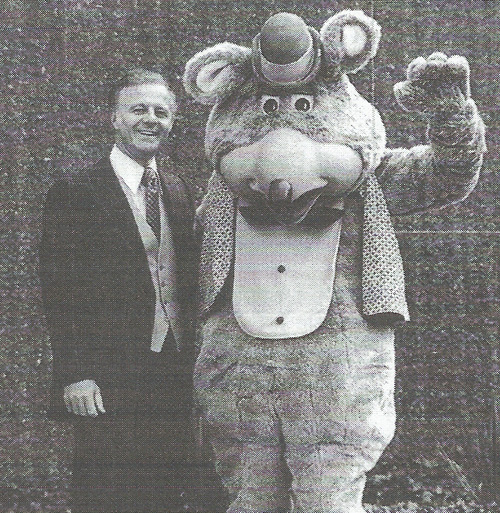
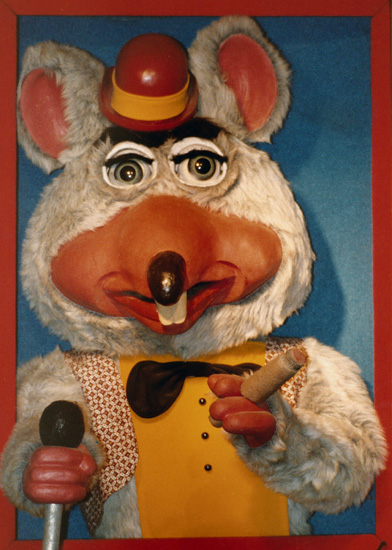
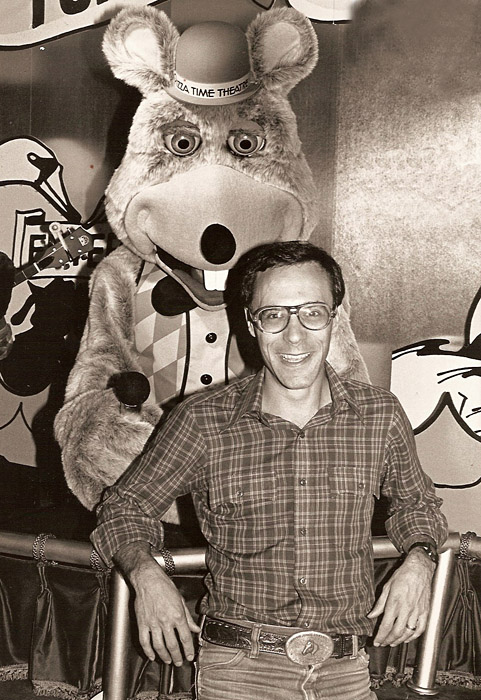
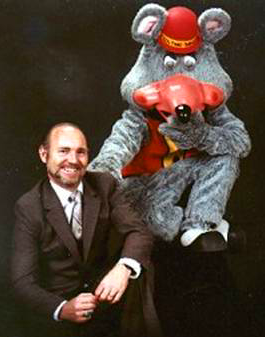
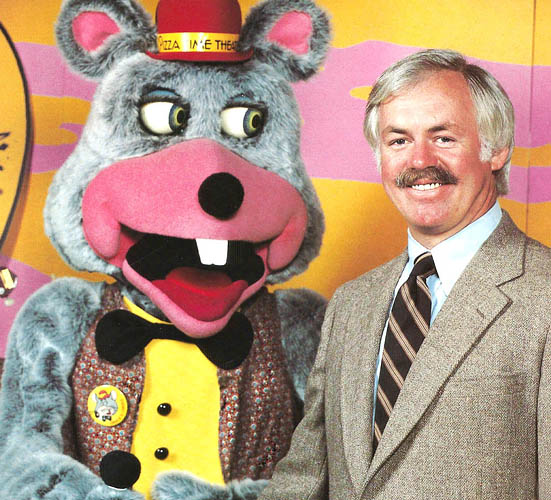
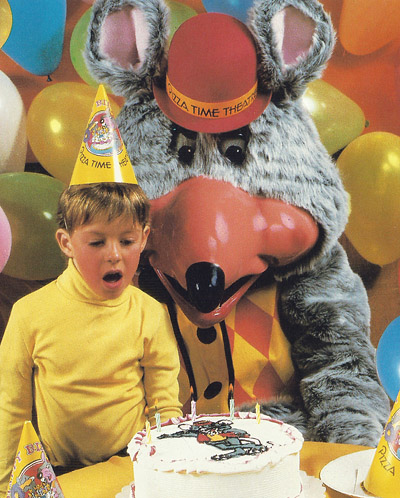
In the beginning Chuck E. Cheese was very much a rat despite the friendlier sounding name. He had a pointy snout, a long tail, and protruding teeth. Chuck E.'s outfit consisted of a red derby, a plaid or paisley patterned vest with a yellow undershirt, and a bow tie. He was often pictured holding a cane and a cigar8. The cigar was actually incorporated into both the walkaround costume and Chuck E.'s animatronic counterpart, however it was officially discontinued in 1980 when Chuck E. gave up smoking during the "Great American Smoke-Out" campaign9. In the first few years, Chuck E. was commonly called "The Big C" or sometimes just "Big C" by the other characters - a little nod to the fact Atari stopped them from naming him "The Big Cheese" as originally intended.
John Widelock was the voice of Chuck E. Cheese from 1977 through 1984, and he was responsible for much of the character's early personality. On the original Pizza Time Theatre demo reel, Widelock performed the voices for all the characters, but it was soon decided to go with different voice actors to decrease the amount to post-production required and increase the overall chemistry between the characters. He was given the choice of which character he wished to keep, and naturally he chose the star of the show - Chuck E. Cheese10.
Chuck E.'s personality was based upon the character "Muggs McGinnis" portrayed by Leo Gorcey in the 1930s-1950s. During his youth, Widelock used to watch Muggs McGiness in various comedies and he found it to be a perfect inspiration for Chuck E. Cheese10. This early incarnation of Chuck E. was fairly abrasive. A loveable thug of sorts - he often came across as abrasive, but his quirks such as constantly dropping misguided malaprops revealed him to be more of a harmless idiot who was trying to maintain control of the show over the other characters.
Another person who was quite influential to Chuck E. Cheese in the early years was Robert Allen Black. He was in charge of the advertising firm that Atari / PTT utilized to produce show material and who originally helped create the characters including Chuck E. Cheese. Mr. Black claimed that an oral agreement made before PTT Inc. broke away from Atari gave him certain copyright and trademark ownership rights to the characters he helped create. In April of 1983, Mr. Black took PTT to court seeking $60 million in damages11. John Widelock had agreed to appear in court to testify on behalf of Mr. Black, however he was never called upon and from what he recalls the lawsuit was settled out of court10.
The 1980s
By 1984 Widelock was replaced as the voice of Chuck E. by Scott Wilson, who had been working alongside Widelock as the voice of Mr. Munch since 1978. In 1983 Bushnell was trying to put together an animated Christmas special starring Chuck E. Cheese known as "The Christmas That Almost Wasn't". The film was never completed, but was intended to be animated by Bushnell's new animation division called Kadabrascope12, and sent to NBC as a pilot. During the recording of the audio, Bushnell and the engineers became frustrated with Widelock's apparent inability to sing. Scott Wilson was given a chance to sing as Chuck E., and after nailing the show's final song on the first take, he was given the reigns to the character on the spot13.
Although Chuck E.'s personality began to warm toward the end of Widelock's tenure, he really started to become a friendlier rat while voiced by Wilson. Aside from a brief interruption in 1986 following PTT's bankruptcy and acquisition by ShowBiz where a replacement voice actor was used14, Wilson continued to be the voice of Chuck E. Cheese into the mid-1990s. Wilson's tenure as Chuck E. Cheese became quite iconic - he was instrumental in transforming Chuck E. from a wise-cracking bully, to a character that had more depth and appeal to kids. He was also the voice of Chuck E. during some of the biggest changes and expansions made during the 1990s, which brought Chuck E. to a whole new audience of children15.
During the 1980s, Chuck E.'s appearance became more standardized. Harold Goldbrandsen, who designed and built the original Chuck E. Cheese animatronic and walkaround costume, had given him a paisley vest because he just happened to have that material lying around16. Once the growth of PTT forced the company to take the manufacturing in-house, they struggled to maintain consistency based on Goldbrandsen's original design. The paisley material was fairly unique and wasn't readily available, so they began using a brown material that was patterned with tiny blue flowers - which from a distance resembled the paisley pattern. As part of a larger redesign of the PTT branding, Chuck E. was given a new yellow and red diamond patterned vest in May of 198117. Rather than rely on outside vendors to source the material, they used a silkscreen method to apply the pattern to ensure his look would always be the same16. By 1982 they simplified Chuck E.'s look even further by making his vest solid red to match his derby. From the beginning there had been a huge difference of opinion regarding Chuck E.'s long snout, with many people such as Goldbrandsen arguing that they needed to "smooth it up" to make it look more like Mickey Mouse16. This finally happened around 1982, and though he was still considered to be a rat, his look became much softer and more like that of a mouse. This appearance became so famous, iconic, and recognizable that it was used solely to describe the replacement of The Rock-afire Explosion with the Chuck E. Cheese characters in the "Rolfe and Earle Show"18 as the 1980s came to a close. Hints about the forthcoming changes were given by dropping clues like "big ears", "red derby hat", "long nose", "vest and a bow tie", "big teeth", etc.
The 1990s
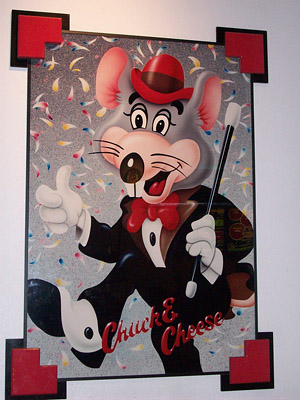
The 1990s brought a variety of changes to Chuck E. Cheese's image. Around the turn of the decade, ShowBiz Pizza Time, Inc followed through with a revamp of all ShowBiz Pizza Place stores which they code-named "Concept Unification"15. This revamp involved bringing the two similar restaurant concepts under the single header of Chuck E. Cheese's Pizza. Although the Chuck E. Cheese character had been appearing at ShowBiz stores for several years, he was now the featured mascot, both on stage and in walkaround form, and on all merchandise. With the debut of Concept Unification, Chuck E was given a classy makeover that featured him in a gold-trimmed, black tuxedo; though he retained his signature red derby.
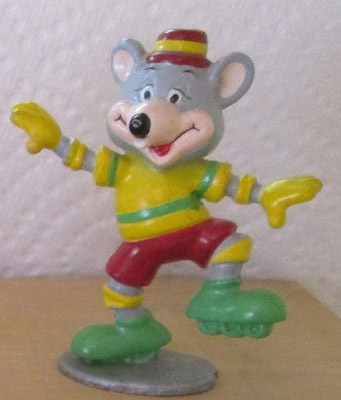
The tuxedo look lasted for only a few years however, as Chuck E. Cheese's Pizza began experiencing heavy competition from a new Family Entertainment Center called Discovery Zone that had entered the market in 1989. This new concept featured more physical activities and attractions for children and was rapidly expanding following an initial public offering in 1993. The pressure it put on SPT was enough to cause them to begin altering their restaurants, including some key alterations to Chuck E. Cheese himself. Gone was the classy tuxedo, as Chuck E. began taking on a more 'hip' fashion. This attempt at appealing to a younger more active audience now featured Chuck E. dressed in a long-sleeved yellow shirt and red shorts. Merchandise often depicted him partaking in more physical activities such as inline skating and surfing. Although Chuck E. managed to retain his red derby, the new look was quickly incorporated to the walkaround costume, merchandise, advertising, and also into a new logo that was in development.
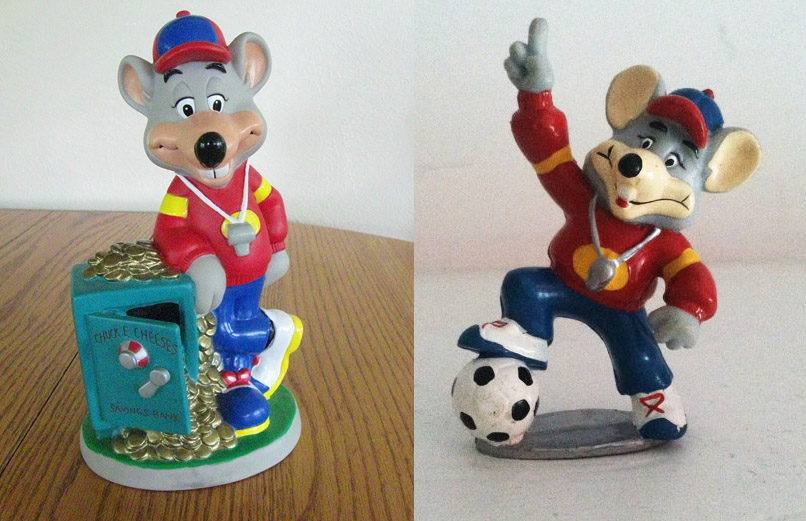
By 1994 the pandering to the younger generation had reached a new peak, as the "Thumb Chuck" era was rolled out19 - a reference to the pose Chuck E. had in the new restaurant logo where he gave customers a "thumbs up"20. The stores were rebranded to become simply "Chuck E. Cheese's", and soon after Chuck E. was again given a fresh look. Gone forever was the red derby, replaced by a baseball cap, and he was now dressed in a long-sleeved red shirt, blue pants, and usually had a whistle around his neck. He continued to be depicted in physical and sporty activities, which complimented new attractions such as the Skytubes that were being installed to keep pace with the competition from Discovery Zone.
During this transitional period that took Chuck E. Cheese from a street-wise New Jersey rat to a sporty mouse, other prominent changes were taking place while attempting to rebrand the character. Most notably, Chuck E. Cheese was given a new voice in 1993. Duncan Brannan began taking on the role of Chuck E., replacing Scott Wilson after a nearly 10 years of voicing the rat. At first Brannan modeled his version of Chuck E. close to the style and accent portrayed by Wilson, but over time began developing his own style of Chuck E. As Brannan has stated, "that was part of my assignment, morphing Chuck E. Cheese from a joke-telling, sometimes off-color New Jersey rat to a lovable, mainstream mouse who could sing."25
The 2000s
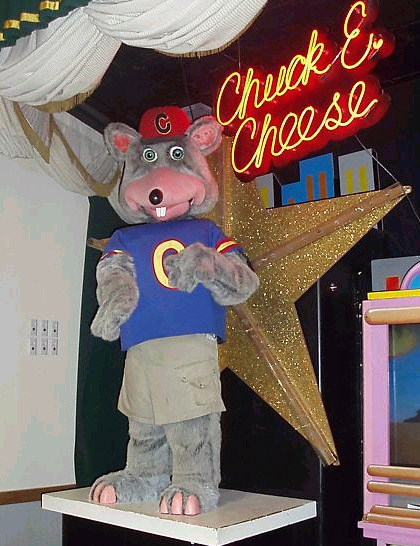
With the start of the new millennium, Chuck E. Cheese continued evolving his look and appearance. During the late 1990s there was a new version of Chuck E. referred to as "Cool Chuck" which featured him in a purple shirt and green shorts. This look was primarily used in commercials and advertising at the start, but was introduced to merchandise beginning in early 2000. By 2001 Chuck E. was dawning a new blue version of the "Cool Chuck" outfit, which became widely used on the animatronic and walkaround versions of Chuck E., and also featured in the showtapes produced by CEC's Entertainment Department.
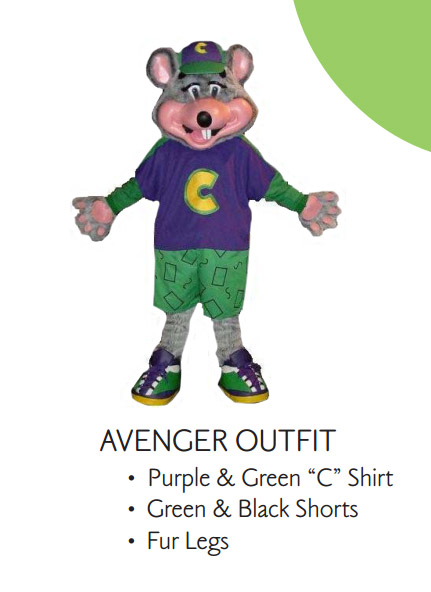
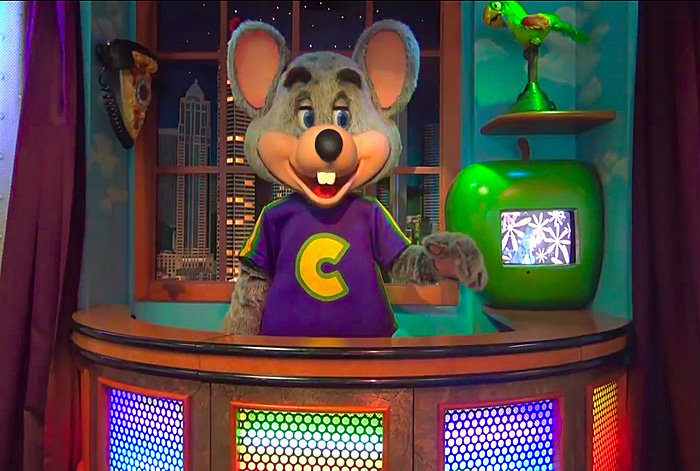
In 2004, Chuck E.'s look was finally starting to become standardized across all fronts. A new rebranding, known commonly as the "Avenger" look21, became the standard. It was a slight variation of the original "Cool Chuck" outfit that Chuck E. had been using off-and-on for several years. This new look featured Chuck E. in a purple baseball cap, a purple shirt, and green shorts. A new company logo was developed featuring "Avenger" Chuck E. giving his usual thumbs-up20. In the next few years, this look was rolled out to the different animatronic shows as well as the walkaround versions of Chuck E.
2012 Revamp & Controversy
On May 3, 2012 it was announced that Chuck E. Cheese would be getting a makeover in order to combat a first quarter slide in sales, revenue, and profits22. Spearheading the new ad campaign was the Dallas based Richards Group who was given the goal to contemporize Chuck E. Cheese for a July 2012 debut.
Character artist Chris Ayers' initial concept artwork contained some fairly drastic alterations to the character including enlarged ears, a less-defined chin, and most notably, the return of his tail that had been missing since the 1990s. By the time the final character design was completed and submitted for trademark, a few alterations had been made such as shortening his sleeves and altering the color of his shirt to match the "avenger" purple and green theme that he's worn since 2004. Perhaps the largest change was the way in which the new Chuck E. Cheese was actually portrayed - aside from being composed entirely with CGI animation, Chuck E. was shrunken down to the size of an actual rat23, a drastic alteration from any way he's been represented in the past.
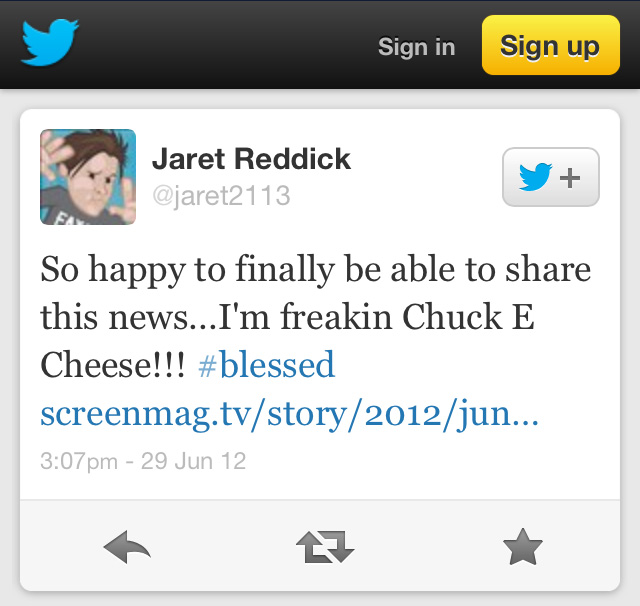
For the new advertising campaign, a new voice actor was utilized which led to some unexpected controversy that spilled into the media. Jaret Reddick, best known as the lead singer for the band Bowling for Soup was hired for the singing and speaking voice of Chuck E. in the campaign. In the days leading up to the campaign launch, Chuck E. Cheese Entertainment released a preview of "Chuck's Hot New Single" via e-mail to those who signed up for their e-mail club24. After receiving the e-mail containing the mp3, a group of fans contacted Brannan to get additional information. After hearing the song himself and contacting a source at CEC's corporate offices, Duncan was informed that he had been replaced. He then issued a press release to the fans25. ShowBizPizza.com collected and archived this farewell press release with the intention of referencing it at a later date. Within a few days, local news outlets in the Dallas area picked up on the story, and before long it had spread across the internet to various national news outlets and blogs such as Gawker, Perez Hilton, and the Huffington Post. On July 3rd, the AP released their article which was then sent to dozens of media outlets. Chuck E. Cheese Entertainment, Inc. has since denied that Duncan was fired, and stated that although freelance, he is still in contract with the company to provide entertainment in its restaurants26. Reddick has since maintained the role of Chuck E., and has brought a fresh "rock-star" persona to the character, often performing original songs written by himself exclusively for Chuck E. Cheese's.
1 - Press Release, "Chuck E. Cheese's Celebrates 30 Years of Success"
2 - 1977 Pizza Time Theatre Program
3 - ShowBizPizza.com correspondence with Nolan Bushnell
4 - Nolan Bushnell Interview - People Are Talking (1982 Episode)
5 - Atari Inc: Business is Fun
6 - ShowBizPizza.com correspondence with Gene Landrum
7 - Nolan Bushnell Interview - G4 Icons (2002 Episode)
8 - 1978 Pizza Time Theatre Franchise Brochure
9 - The Pizza Times - Volume 2, Number 1 - May, 1980
10 - ShowBizPizza.com correspondence with John Widelock
11 - Pizza Time Theatre 1983 Annual Report
12 - The Pizza Times - Volume 3, Issue 2 - June, 1983
13 - ShowBizPizza.com correspondence with Scott Wilson
14 - Showtape Review - History of Rock and Roll (July 1986)
15 - Showtape Review - Concept Unification Premiere (Circa 1990)
16 - ShowBizPizza.com correspondence with Harold Goldbrandsen
17 - The Pizza Times - Volume 1, Issue 1 - May, 1981
18 - Showtape Review - The Rolfe and Earle Show
19 - Informational Sheet from 1998 Storybook Crystal Corporate Gift Set
20 - ShowBizPizza.com University - Restaurant Logos
21 - CEC University - Costume Character Manual 2006
22 - New look planned for Chuck E. Cheese character - The Dallas Morning News (5-3-12)
23 - Chuck E. Rocks - Screen Magazine (6-29-12)
24 - Advertisement for CEC's New Single - Official CEC Facebook Wall Post (6-25-12)
25 - Press Release: "Former Voice of Chuck E. Cheese Reacts to His Replacement"
26 - Chuck E. Cheese transforming into a rock star - MSNBC Business, Updated AP Article (7-3-12)